Wayhomart
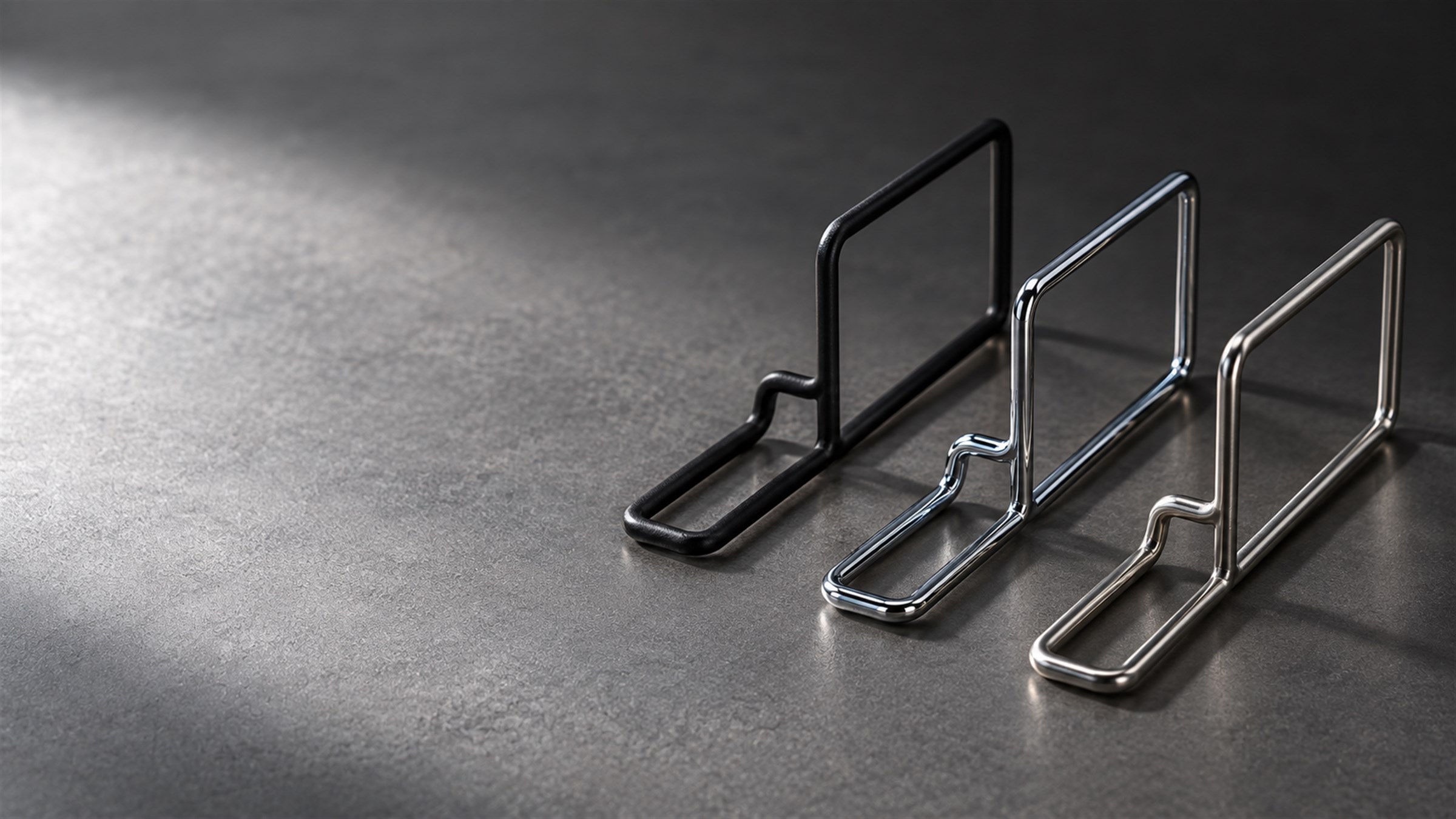
Buyers usually ask about finish in terms of appearance: matte black or shiny chrome. The more useful question is which finish survives the compliance route of the market you are selling into, and then whether it survives the way the product will actually be used.
Those are two different questions, and the answer to the first one narrows the second.
The short version
- Powder coating gives the widest freedom (any RAL tone) and hides substrate imperfections. It is the default for retail black and white SKUs. The costs are edge coverage and what happens after an impact.
- Chrome plating gives the reflective look buyers associate with premium kitchenware, but a scratch exposes the substrate and it is harder to keep compliant across markets.
- Electropolishing is for stainless parts where you want corrosion resistance without a coating at all, which requires the substrate to be stainless in the first place.
A finish is a combination, not a colour
It is not “a layer of colour”. It is substrate × pre-treatment × coating or plating × destination market, and changing one of the four can change the conclusion for the other three:
- Move from carbon steel to SUS304 and the corrosion strategy shifts from “block it with a coating” to “rely on the substrate”. Only then does electropolishing become an option.
- The same black reads differently in powder coat and in e-coat, because edge coverage differs and so does behaviour in a dishwasher.
- The same coating sold into North America and into Germany does not require the same set of documents.
How the three options differ
| Finish | Appearance | Source of corrosion resistance | Repairability | Main risk |
|---|---|---|---|---|
| Powder coated | Any RAL tone, matte or gloss | Coating barrier plus pre-treatment | Poor — an impact usually means redoing the part | Thinner coverage on edges and weld points |
| Chrome plated | High reflectance, metallic | Plating plus base layer | Poor — a scratch exposes substrate | Scratch damage is permanent; compliance across markets is more complex |
| Electropolished | Bare metal, evenly matte | The stainless substrate itself | Local re-polishing possible | Stainless only; cannot change colour |
Changing finish is not changing a colour code. Powder coating, chrome plating and electropolishing run on three different lines, with different jigging, pre-treatment and yield. That is why the choice moves the quotation.
The part people miss: decide before tooling
Food-contact regulation restricts what may contact food. A coating that is acceptable in one market can require additional migration testing in another.
That means the finish has to be fixed before the tooling is cut. Changing it later usually invalidates the sample and the test report together, and the fixtures may already have been designed around the old jigging.
The compliance route by market
The table shows which route applies. It does not mean any given model already holds every applicable qualification. That has to be confirmed per material, use and model:
| Market | Food-contact basis | Usually requested as well |
|---|---|---|
| North America | FDA 21 CFR | California Proposition 65, NSF |
| European Union | EU 1935/2004 | REACH, RoHS |
| Germany | EU 1935/2004 plus LFGB | REACH, RoHS; migration testing is stricter in practice |
| Brazil | ANVISA | INMETRO (mandatory for part of the category), Portuguese labelling |
| Mexico | NOM | Spanish labelling and commercial information |
The same rack sold into different markets may need a different coating and a different report. The moment “exporting to Europe” becomes “the German market”, the test list can change.
Dishwasher and salt spray are two different problems
- A dishwasher is a chemical and thermal cycle: detergent, an alkaline environment and repeated heating attack adhesion and edges. Products that live in a dishwasher have a noticeably narrower set of viable coatings and plating systems.
- Salt spray is a corrosive environment: it measures how long a coating or plating resists salt-laden moisture. It is not the same test.
Buyers often phrase both as one requirement, and then neither is met well. Written separately, a supplier can answer each with a specific proposal.
Colour and RAL: not every colour costs the same
- Dark tones (black, dark grey) cover well and are the most forgiving of substrate marks, the retail default.
- Light and white tones are more sensitive to pre-treatment and coating thickness; weld points and edges show through more easily.
- Metallic and special effects usually need extra steps or a different coating system, which affects both lead time and yield.
Specify a RAL number plus gloss level. “Black” leaves the decision to the factory.
What actually drives the cost
The difference in finishing cost comes mostly from the process, not the paint:
- Pre-treatment stages (degreasing, derusting, phosphating) and whether manual touch-up is needed.
- Jig design. The more masked area, the more coating and labour are wasted.
- Yield. Dark colours hide defects, light colours expose them. Same line, two different yields.
- Testing. Third-party migration testing or salt-spray reports cost money and calendar time.
Decision order
- Destination market and its compliance route.
- Use case: dishwasher or not, permanently damp or not.
- Substrate: carbon steel, SUS201, SUS304 or aluminium.
- Finish and colour (RAL plus gloss level).
- Packaging and transport: impact protection for the coating feeds back into carton design.
Write those five into the RFQ and the quote becomes comparable.
A checklist for your next RFQ
- Destination market and the compliance route it implies
- Dishwasher exposure: yes or no
- Salt-spray expectation and standard, if the product will be used near water
- Whether the retail brand accepts a visible substrate if the coating chips
- Colour (RAL) and gloss level
- Whether third-party reports are needed, and for which market
The process limits and available finishes are described under surface finishing; for how the choice plays out inside a category, see the dish rack range or the finish options on the expandable two-tier dish rack.
Once the finish is fixed, the next decision that changes the cost structure is packaging and container loading, see KD vs welded wire racks.