Wayhomart
Cutting dish rack freight with knock-down frames
A European kitchenware importer was paying to ship air on a welded dish rack. Re-engineering the frame as knock-down cut container volume without changing the retail appearance.
Challenge
The existing welded dish rack shipped as a fixed frame. Because a three-sided wire frame is mostly empty space, the importer was paying ocean freight on air. With container costs rising, the landed cost of the SKU became uncompetitive against locally sourced alternatives.
What we did
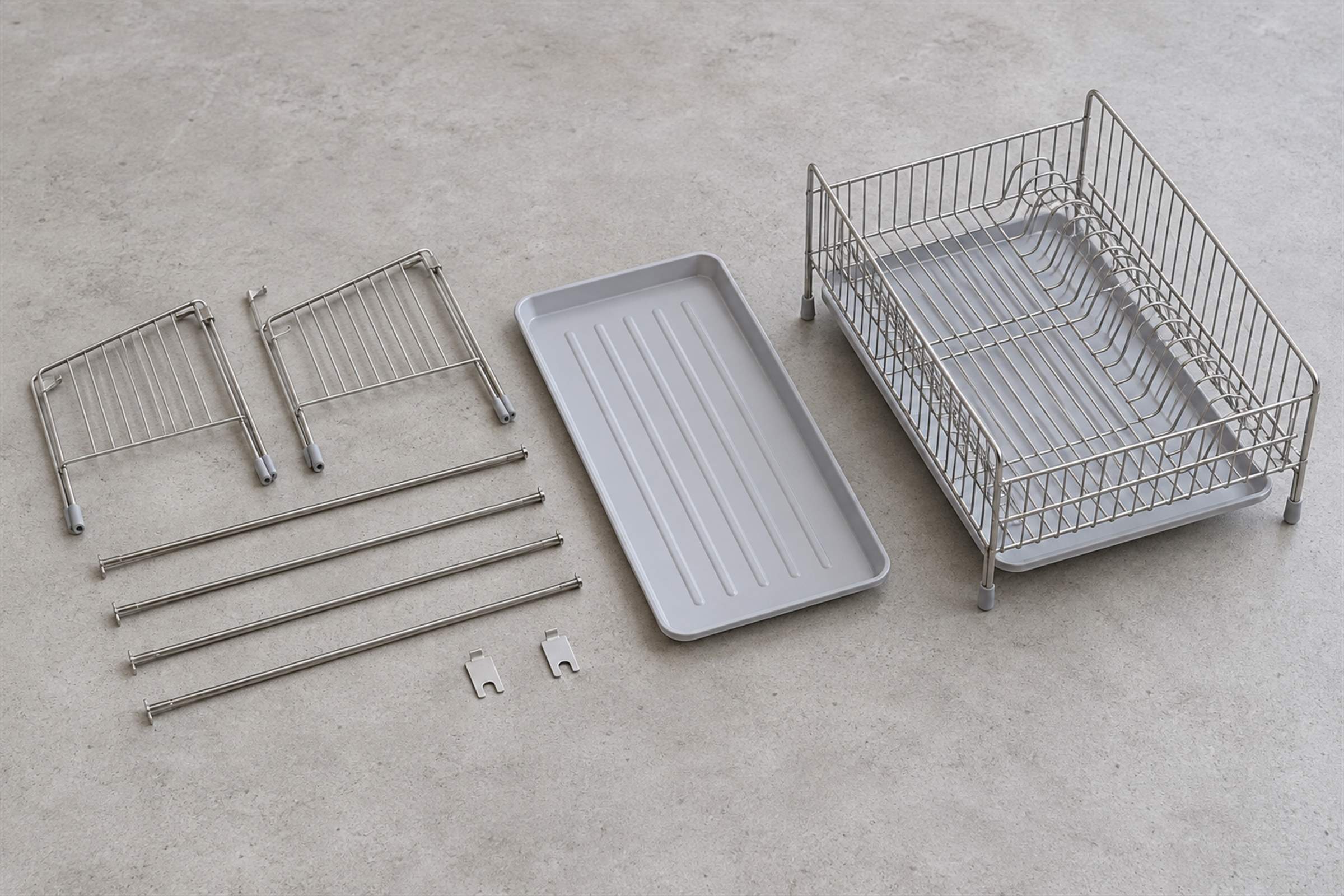
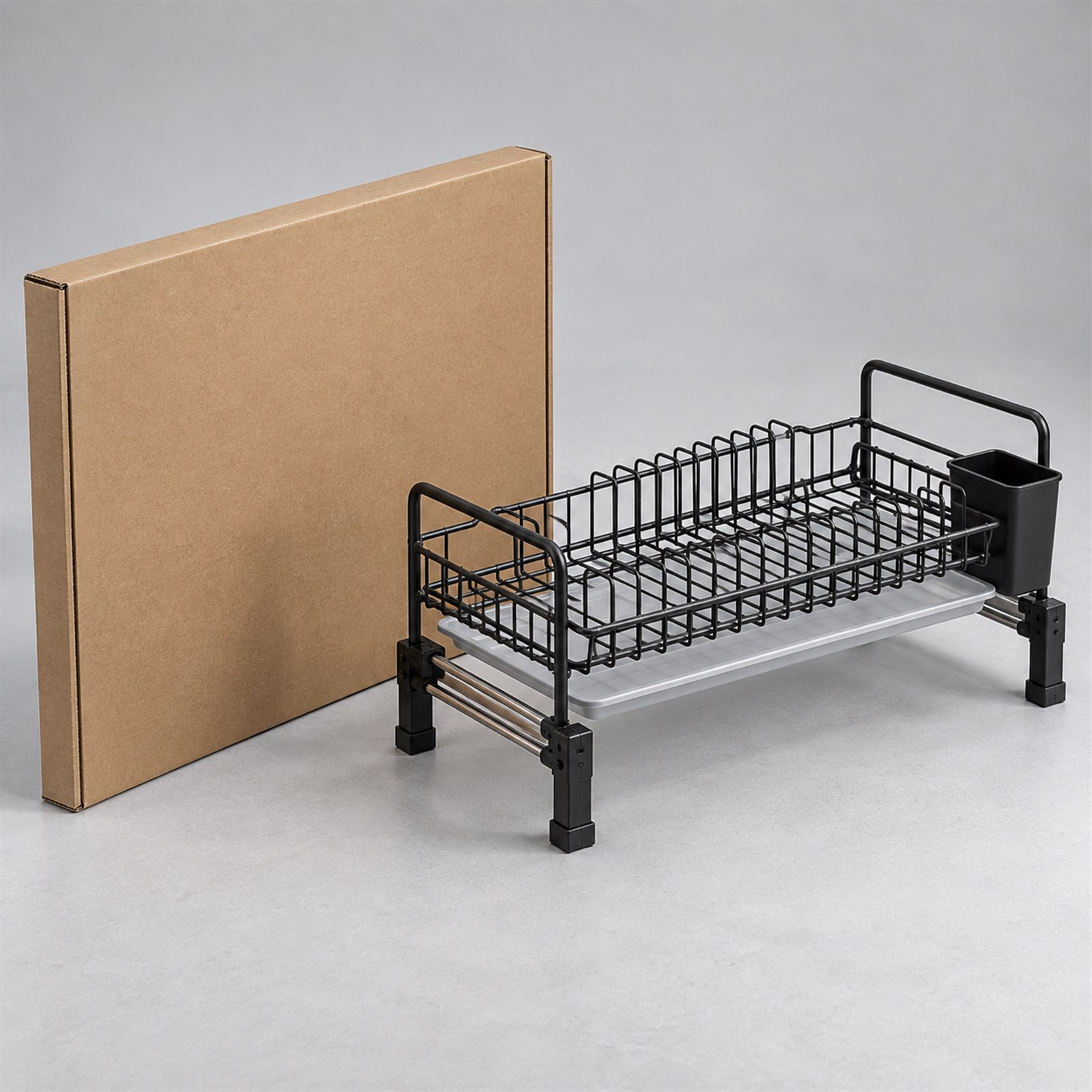
We redesigned the frame as a knock-down assembly with two locking tabs and a revised rail joint, so the finished product still presents as a single rigid unit once assembled, but ships flat. Tooling was revised for the new joint and the packaging was re-cut to the flat footprint.
Result
- Flat-pack carton replaced the fixed-frame carton
- Assembly is tool-free and takes under a minute
- Retail appearance unchanged once assembled
Why this is worth reading
Freight is often the largest controllable cost on a bulky wire product, and it is usually ignored during sampling — because samples ship by courier, and couriers price on weight rather than volume.
The real cost appears after mass production. A three-sided wire frame encloses mostly air, but shipped as a fixed frame the carton has to enclose all of it. You pay for the outside volume of the box, not for the weight of the wire.
Where the project started: the packaging was the problem, not the product
The welded version had already been accepted by the market on function and appearance. The problem was that it could only ship as a fixed frame: carton size followed product size, with nothing left to compress.
As container costs rose, the landed cost of the SKU stopped competing with locally sourced alternatives. The importer had three options:
- Switch to a smaller product — giving up the display effect it was bought for.
- Accept a worse landed cost — giving up margin.
- Change the structure so the same product ships in a smaller box.
The third option costs tooling and re-validation, but it is the only one that does not change the outcome at retail.
The trade-off: knock it down, keep it rigid
Knocking a frame down is easy. Keeping it rigid enough that the retail customer does not perceive a downgrade is not.
That trade-off has three concrete checkpoints:
- No perceptible movement at the joints. Under load, a three-sided frame concentrates torque at the connections. Once a joint loosens, the whole rack feels loose.
- No tools at assembly. A spanner in the retail carton transfers the installation cost to the consumer.
- The assembled product must read as one object. Seams, step-offs and the edge treatment of the finish are all judged here.
What we did: two locking tabs and a revised rail joint
The difficulty sat in two places:
The locking tabs. Two tabs lock the opened frame into a rigid body. Their position follows the load path, not the appearance — the easiest mistake at sampling, because a symmetrical-looking position is not necessarily the most efficient one.
The rail joint. The original rail joint was designed for a fixed welded angle. A knock-down structure needs it to locate in both the folded and the open state, so the joint was redesigned wholesale. Tooling was cut for the new joint.
The carton was re-cut to the flat footprint as well. This is often treated as a packaging task, but it feeds back into product design: once the carton size ceiling is fixed, the ways the product can be split are limited.
Verification: three results we can state
- A flat-pack carton replaced the fixed-frame carton.
- Assembly is tool-free and takes under a minute.
- The retail appearance is unchanged once assembled.
These three can be stated because they describe structure and use. They do not depend on a commercial figure.
What this case does not publish
The specific reduction in volume and the change in landed cost are the client’s commercial data, and they are not published here without authorisation. Nor will we fill in an estimate to make the page look better — that would amount to making a promise on the client’s behalf.
What can be published is the method: work out CBM per unit first, then discuss unit price. The arithmetic is in KD vs welded wire racks, and any buyer can re-run it with their own carton dimensions.
Four transferable principles
- Look at container loading before structure. Structure decides how small the carton can get; the carton decides the loading.
- The joint is the whole of a KD design. Until the tabs and the joint are solved, everything else is secondary.
- Cost the tooling together with the loading. Tooling always looks expensive on its own; only amortised per unit does it produce an answer.
- Do not trade protection for volume. A flat-pack has different load points from a fixed frame, so drop and vibration testing has to be redone.
Where to go next
- The category this case belongs to: dish rack range.
- How the structure is made: wire forming and welding.
- Comparing two options of your own: the KD volume calculation.
- Preparing a quotation request: the 11 inputs of a dish rack RFQ.
Related product ranges
Send us your drawing or sample
Tell us the application, target market and annual volume. Our engineering team will review feasibility, tooling and lead time.